
My former mother-in-law told me not to bring my eight-year-old triplets to their father’s burial at Arlington because, in her words, "those children were an embarrassment Nathan had outgrown."
She expected me to obey.
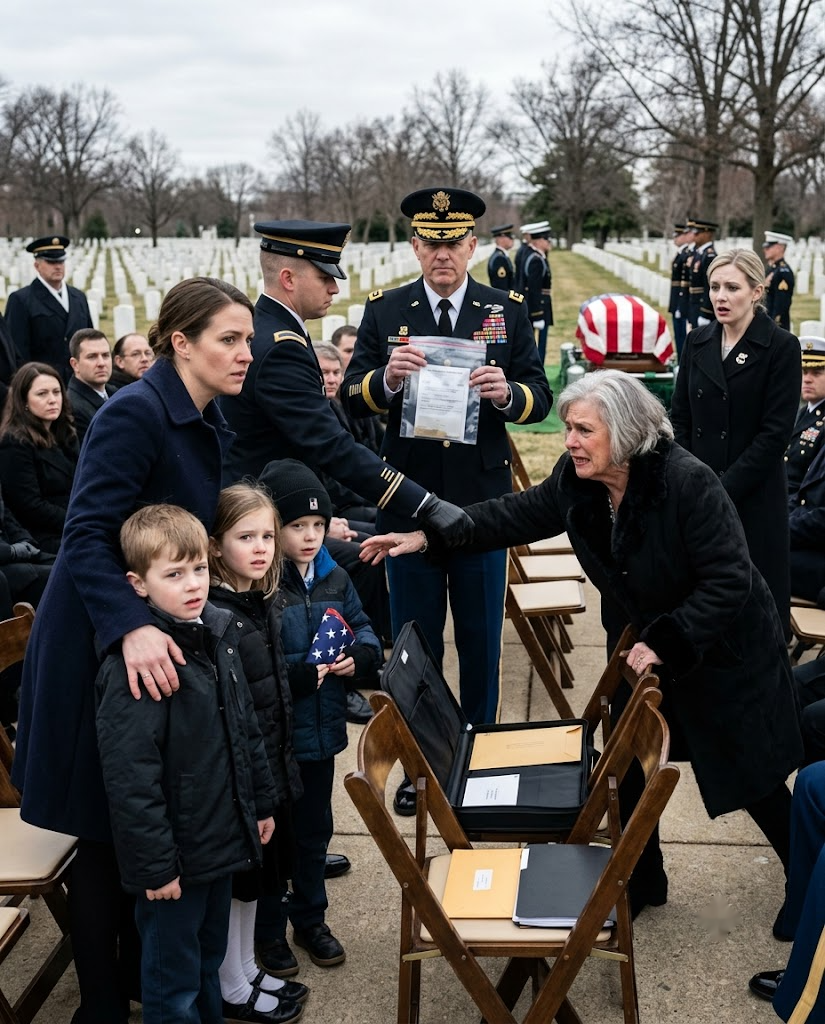
Instead, halfway through the ceremony, a four-star general walked past her, stopped in front of my children, and ordered an aide to open a sealed charcoal case Nathan had left specifically for them.
Three mornings earlier, I had been pouring cereal when the secure phone from my old intelligence job vibrated beside the fruit bowl.
My personal phone rang seconds later.
The television confirmed it before either caller could finish.
Major Nathan Mercer had died during an overseas recovery mission after getting two injured Americans onto an evacuation aircraft.
For a long time, I stared at the photograph the network used.
Nathan and I had divorced when Owen, Claire, and Ben were still toddlers.
Our marriage had not survived the strain of deployments, newborn triplets, and two careers built around information we were often forbidden to share with each other.
The divorce had been painful.
His relationship with the children was more complicated.
Nathan called when he could. Sometimes three times in a week, sometimes not for two months. He mailed postcards from bases whose locations he could not explain. He missed school plays, then somehow remembered which child had played which tree in which ridiculous kindergarten production.
The children never stopped calling him Dad.
Then Judith Mercer texted me.
"Nathan will be buried Friday. Vanessa will sit with the family. Do not bring those handout children and turn his funeral into a custody spectacle. Vanessa is his widow. Respect that."
I read the message twice.
Then I saved screenshots to my personal cloud account, an encrypted archive, and a thumb drive in my desk.
Old habits from intelligence work die slowly.
Ben noticed my face from across the kitchen.
"Is Grandma Judith mad at us?"
"No," I said. "She made a decision. Those are different things."
Owen looked up from his cereal.
"Are we going to Dad’s funeral?"
Before I could answer, the doorbell rang.
A dark government sedan was parked outside.
A casualty affairs officer stood on my porch carrying a sealed packet.
Inside were four Arlington access credentials—one for me and one for each child.
A typed instruction was clipped behind them.
Ms. Mercer and the three Mercer children are to be seated where General Cross can identify them immediately. Do not depart before presentation of the protected family materials.
At the bottom was a case number from the Department of Defense Inspector General.
There was no handwritten explanation.
There did not need to be.
I had spent enough of my professional life around investigations to recognize deliberate language.
Someone had anticipated resistance.
Someone had expected Nathan’s children might be kept away.
Judith called that evening.
"You received credentials," she said.
It was not a question.
"Yes."
"Nathan changed things while he was sick with guilt," she replied. "Vanessa stood beside him. You took the children and left."
"Nathan signed our divorce agreement too," I said. "He knew where his children lived."
Her breathing changed.
"Stay away Friday."
"No."
"Leah, do not make me involve security."
"The credentials came through casualty affairs. Security can call them."
For several seconds, neither of us spoke.
Then Judith lowered her voice.
"You have no idea what is inside that case."
That sentence mattered more than everything else she had said.
I had never mentioned a case.
"Good night, Judith."
I ended the call.
Friday morning, Arlington was gray and cold, the kind of cold that slipped beneath a coat collar and settled against the skin.
Owen wore the navy tie Nathan had mailed him for his eighth birthday.
Claire carried a folded drawing in her coat pocket.
Ben held my hand so tightly my fingers ached.
Vanessa stood beside Judith in the first row wearing Nathan’s silver aviation badge pinned to her black coat.
Vanessa had married Nathan two years after our divorce.
I had met her only twice.
She was not responsible for the end of my marriage. I had always made that clear to the children.
But I also knew she had never encouraged Nathan to bring them into her life.
When Judith saw us walking toward the chairs, she stepped directly into the aisle.
"I warned you."
Owen stopped.
Claire moved closer to me.
Ben looked past Judith toward his father’s flag-covered casket.
"We came to say goodbye," Claire whispered.
Judith glanced at several relatives watching us.
"Your father had a new family."
Nobody spoke.
Nathan’s uncle studied his shoes.
One cousin turned toward the cemetery road.
An aunt adjusted her gloves as though she had suddenly discovered something fascinating about the stitching.
Vanessa touched the badge on her coat.
"There are seats in the back," she said. "Please don’t make this ugly."
I could have argued.
I could have told every relative standing there exactly what Judith had texted me.
Instead, I showed an Arlington official our credentials.
He read them, looked at Judith, then quietly spoke into his radio.
I walked the children to the final row.
Judith smiled as though restraint meant defeat.
Minutes later, four-star General Adrian Cross arrived with a military attorney and an aide carrying a narrow charcoal case secured with two numbered seals.
Judith hurried toward him.
"General, this is Nathan’s wife, Vanessa."
General Cross nodded politely at Vanessa.
Then he looked beyond her.
His eyes found us immediately.
He walked down the aisle.
Every relative watched him pass.
He stopped in front of Owen, Claire, and Ben.
"Children of Major Nathan Mercer?"
They nodded.
The general removed his gloves.
"Your father asked me personally to make sure you were here."
Claire’s chin trembled.
"You knew Dad?"
Cross gave her a small smile.
"Very well."
Judith pushed through the aisle behind him.
"General, Nathan was under enormous stress. Whatever he told you—"
Cross turned toward her.
"Mrs. Mercer, I was present when he gave the instructions."
Judith froze.
The aide placed the charcoal case on an empty chair and broke the first seal.
Vanessa’s hand dropped from Nathan’s badge.
Inside were a black folder, three cream envelopes bearing the children’s names, and a smaller sealed evidence pouch.
General Cross opened the folder.
"Before we proceed with military honors," he said, "Major Mercer requested correction of his official family contact record."
The military attorney stepped beside him.
Cross removed the first page.
"He also documented repeated interference with his attempts to communicate with his children."
Judith’s face emptied of color.
Then the attorney produced three certified delivery receipts.
All three carried the same signature.
Judith Mercer.
General Cross looked directly at her.
"These were letters Nathan sent for his children eighteen months ago. According to the investigative record, you signed for every one of them."
Ben looked up at me.
"Mom… what letters?"
I could not answer.
I had never seen them.
Judith suddenly reached toward the folder.
The aide closed his hand over it first.
Cross did not raise his voice.
"Do not touch the evidence."
The entire front row went silent.
Then he lifted the smaller sealed pouch.
"Because the letters were not the only thing Major Mercer left behind."
Vanessa stared at the pouch.
"No," she whispered.
General Cross kept the evidence pouch in his hand while the military attorney turned the certified receipts toward Judith.
The attorney explained that Nathan had initially mailed the letters to his childhood address because Judith repeatedly told him I refused military correspondence and returned anything he sent.
The dates were spread across nearly a year.
Each receipt showed delivery.
Each showed Judith’s signature.
Then the attorney removed another document from the folder.
It was an Inspector General summary.
Six months before his death, Nathan had contacted casualty affairs after a video call with Owen.
During that call, Nathan apparently mentioned a letter about Owen’s science competition.
Owen had looked confused.
"What letter?" he had asked.
That question had started everything.
Nathan began checking tracking numbers.
The letters had not been returned.
They had been delivered.
To his mother.
Judith shook her head as the attorney read.
"He misunderstood. I was protecting him from more rejection."
"From rejection?" I asked.
She looked at me with something close to fury.
"You poisoned those children against him."
Owen spoke before I could.
"No, she didn’t."
Judith turned toward him.
Owen’s voice shook, but he continued.
"Dad missed things. Sometimes I was mad. But Mom never told us not to talk to him."
Claire nodded.
Ben stared at Judith as if seeing her for the first time.
General Cross pulled one cream envelope from the case and handed it to Owen.
Nathan’s handwriting covered the front.
Owen traced his own name with one finger.
Vanessa stepped backward.
"Judith told me Leah returned everything," she whispered.
Judith snapped toward her.
"Be quiet."
That was the moment the family finally stopped looking at me.
Every eye turned toward Judith.
Cross explained that after learning about the intercepted mail, Nathan had amended his emergency instructions personally.
He listed all three children by full name and date of birth.
He required direct casualty-affairs delivery of any protected family material if he died.
He also instructed that no relative outside the designated recipients was authorized to accept or redirect those materials.
Judith’s name was specifically excluded.
The military attorney then opened a second section of the folder.
It contained copies of messages Judith had sent Nathan.
I recognized none of them.
One said I had changed the children’s phone numbers and refused to provide the new ones.
Another claimed the children had asked Nathan to stop calling.
A third told him Claire had cried after receiving one of his birthday packages and wanted it thrown away.
Claire stared at Judith.
"I never said that."
Judith folded her arms.
"You were children. You don’t remember everything."
"I remember Dad’s telescope," Claire said.
Her voice was suddenly firm.
Nathan had mailed her a small beginner telescope the previous Christmas.
She had slept beside the box for two nights because she was so excited.
Judith had told Nathan she rejected it.
Vanessa covered her mouth.
"You told us Leah sent that back too."
Judith looked at her sharply.
"I did what was necessary. Nathan needed peace."
"No," General Cross said. "Nathan needed accurate information."
He looked at the sealed pouch.
Then at me.
"Ms. Mercer, Major Mercer recorded this after receiving the Inspector General’s preliminary findings. He directed that the children hear it if he did not return."
I crouched beside them.
"Do you want to hear Dad?"
All three nodded.
The aide broke the seal.
Inside was a secured memory device.
A small government-approved player was brought forward.
General Cross pressed a button.
Nathan’s voice came through the speaker.
For a second, none of my children breathed.
"Owen, Claire, Ben," he began. "If you’re hearing this, then I didn’t get the chance to fix this in person."
Ben’s hand found mine.
Nathan paused on the recording.
"First, I need you to know something. I never stopped wanting you in my life. Not once."
Claire began to cry silently.
"I believed things I should have checked myself. I let distance become an excuse. That part belongs to me."
He did not blame Judith immediately.
That was so much like Nathan that it hurt.
"When I finally learned that letters and messages were being intercepted, I was angry. But anger is not why I made this recording. I made it because children should never have to guess whether a parent loved them."
Judith stared straight ahead.
Then Nathan’s voice changed.
"Mom, if you are present, hear me clearly. You do not get to decide who my children are. You do not get to erase them because my divorce embarrassed you. You do not get to rewrite my life so it looks cleaner from the front row."
Someone behind Judith gasped.
Vanessa closed her eyes.
"Leah," Nathan continued, "I owe you an apology bigger than a recording can carry. You kept the door open longer than I deserved. Thank you for never teaching them to hate me."
I looked down.
For the first time since learning he was dead, I cried.
His voice softened again.
"Kids, there are three envelopes for you. Those are private. Read them when you want. Not when anyone tells you to."
There was a short silence on the recording.
Then Nathan added one final instruction.
"General Cross has the paperwork for the Mercer Education Trust. I funded it from my personal savings and insurance allocation years ago. It belongs equally to Owen, Claire, and Ben for education, training, or whatever path they build when they are old enough. Nobody else controls it."
Judith’s head snapped toward the general.
That, I realized, was the part she had feared.
Not because she was losing money that belonged to her.
Because the trust destroyed the story she had been telling everyone—that Nathan had chosen a replacement family and forgotten his children.
The military attorney confirmed that the trust had been established legally years before Nathan’s death and that an independent trustee, not me and not Judith, would administer it.
Vanessa looked stunned.
Then General Cross handed her a separate envelope.
"Major Mercer also left materials for his wife. Your status is not being challenged here."
That mattered.
This was not about humiliating Vanessa or pretending my divorce had never happened.
She was Nathan’s widow.
My children were still Nathan’s children.
Both truths could exist at once.
Vanessa looked at me.
"I believed her," she said quietly. "I believed you wanted him gone."
"You could have asked me," I replied.
She nodded once.
"I know."
Judith did not apologize.
Instead, she said Nathan had been manipulated by investigators and guilt.
The military attorney informed her that the Inspector General inquiry into interference with protected family communications remained open and that she would receive instructions regarding preservation of records.
No one arrested her at the funeral.
No dramatic squad of officers appeared.
There was no need.
Consequences had already begun.
The relatives who had ignored my children now knew exactly what they had been helping Judith erase.
The ceremony continued.
This time General Cross personally moved three chairs beside the aisle near the family section.
He did not ask Judith’s permission.
Owen sat rigidly with Nathan’s envelope in his lap.
Claire held hers against her chest.
Ben stared at the folded flag as the honor guard completed its work.
When the final salute ended, General Cross approached the children again.
He carried Nathan’s aviation badge in a small presentation box.
Vanessa had removed it from her coat voluntarily.
"This was loaned to Mrs. Mercer for today," Cross explained. "Your father’s instructions say it is eventually to be held jointly by the three of you."
Vanessa handed the box to Claire herself.
"He talked about you more than I understood," she said.
Claire did not hug her.
She simply answered, "Thank you."
That was enough.
Judith left before most of the guests.
Nobody followed her.
Weeks later, investigators confirmed that she had intercepted more correspondence than the three letters presented at Arlington.
Some had been stored unopened in boxes at her home. Others had been photographed and discarded after she used pieces of their contents to convince Nathan she was keeping him informed.
She had also supplied Vanessa with selective screenshots that made my brief, logistical responses look hostile by removing the messages around them.
The Inspector General referred portions of the matter involving mishandled protected communications to the appropriate authorities, while the family-related issues were handled through attorneys and formal no-contact boundaries.
I did not spend the next year trying to punish Judith personally.
I blocked her access to the children.
I preserved every record.
I let the professionals do their jobs.
Vanessa eventually sent me a written apology.
It did not erase what happened, but I kept it because accountability should be remembered too.
The children opened Nathan’s letters at different times.
Owen waited two days.
Claire opened hers that evening.
Ben carried his around for almost a month before asking me to sit beside him.
Nathan had written something different to each child.
To Owen, he wrote about paying attention to people who were ignored.
To Claire, he wrote about curiosity and the stars.
To Ben, the quietest of the three, he wrote, "You notice what everyone else misses. Never let loud people convince you that means you are small."
Ben read that line three times.
Then he folded the letter carefully along the original crease.
The education trust remained untouched except for its normal administration.
The badge stayed in a glass case in our living room, beside three photographs—not one.
One showed Nathan holding the triplets as babies.
One showed him years later on a rare weekend visit, all four of them covered in flour after attempting pancakes.
The last was taken at Arlington.
It did not show Judith.
It showed Owen, Claire, and Ben standing together beneath a gray Virginia sky after saying goodbye to their father.
For years, other people had tried to decide what Nathan’s absence meant.
Judith said it meant he had moved on.
Vanessa had believed it meant I kept him away.
I had sometimes feared it meant he simply had not tried hard enough.
The truth was less convenient.
Nathan had failed us in some ways, loved his children in others, and realized too late that someone he trusted had been shaping the distance between us.
His final act did not repair seven lost years.
Nothing could.
But it gave the children something more important than a perfect story about their father.
It gave them the truth.
And no one in his family would ever be able to erase them from it again.

