
My parents ignored the hospital while surgeons were opening my skull after I collapsed at graduation.
My sister was posting photos from Rome.
Her caption said, "Best family vacation ever. No emergencies. No guilt trips."
They thought I would wake up, apologize for ruining their trip, and keep protecting them like I always had.
They did not know my grandfather was beside my hospital bed with our corporate attorney and a sealed green folder.
Two days earlier, I had walked across the commencement stage in front of nearly three thousand people.
I was twenty-two and graduating first in my class. Grandpa Elias sat in the front row beside my roommate, Tessa.
Three chairs beside them remained empty.
Mom, Dad, and my older sister, Chloe, had promised they would be there.
I kept checking those seats until the university president announced my name. Then I forced myself to stop.
My head had been hurting since breakfast.
Every heartbeat felt like pressure building behind my right eye, but I had spent most of my life learning that illness was acceptable only when it belonged to Chloe.
When she had migraines in high school, Mom darkened the entire house and canceled dinner plans.
When I once developed pneumonia during finals, Dad told me that successful people did not turn discomfort into theater.
So I walked to the podium carrying my folded speech with both hands and smiled.
"To everyone who helped us reach this day—thank you."
The words sounded as if they were traveling through water.
The stadium lights stretched into white streaks. I tried to focus on Grandpa's face, but the entire front row tilted sideways.
My knees buckled.
I heard someone shout my name.
Then nothing.
When I opened my eyes again, my mouth was dry and my head felt impossibly heavy.
A white bandage wrapped around my skull. An IV ran into my arm, and an electronic monitor pulsed beside me.
Tessa was asleep with her cheek against the mattress and one hand around mine.
Grandpa stood near the window wearing the same clothes he had worn to commencement.
"Grandpa?"
Tessa jerked awake.
He turned so quickly that his chair almost tipped over.
"Ava."
His voice broke on my name.
I tried to sit up, but pain forced me back against the pillow.
"What happened?"
Tessa squeezed my fingers.
"There was bleeding around a mass in your brain. They had to operate immediately."
I stared at her.
"Brain surgery?"
Grandpa nodded.
The neurosurgeon later explained that the mass had caused swelling and a small hemorrhage. The surgical team had removed it and relieved the pressure before permanent damage occurred.
Pathology would take several days.
For now, I was alive, awake, speaking clearly, and moving every limb.
Then I noticed who was absent.
"Where's Mom?"
Neither of them answered.
"Dad? Chloe?"
A nurse named Marisol entered to check my IV, and I asked the question that everyone else seemed to be avoiding.
"Did the hospital call them?"
Her expression changed.
"We contacted every emergency number on your chart."
"Did anyone answer?"
She glanced at Grandpa.
He gave her a small nod.
"Your father answered the second call," she said.
My throat tightened.
"What did he say?"
Marisol chose her words carefully.
"He said the family was overseas and that you had a history of turning stressful situations into crises. He asked us to contact your grandfather instead."
The monitor beside me kept beeping.
For several seconds, nobody spoke.
I had been unconscious while surgeons opened my skull.
Dad had described me as stressful.
Tessa picked up my phone from the bedside table and placed it in my hand.
No message from Mom asked whether I had survived.
There was nothing from Dad.
Nothing from Chloe.
But there was a social-media notification telling me Chloe had tagged me in a photograph.
The three of them were sitting on a rooftop terrace in Rome, smiling beneath strings of lights and raising glasses toward the camera.
The caption read, "Best family vacation ever. No emergencies. No guilt trips. Just peace."
It had been posted four hours after the hospital reached my father.
Tessa looked sick.
"I'll remove the tag."
"Don't."
My voice was weak, but it surprised even me how certain it sounded.
I took screenshots of the post, the timestamp, and the comments beneath it.
Then I asked Marisol whether the hospital could preserve its contact log.
She said it could.
Grandpa watched every movement.
When I finished, he asked, "Did your father tell you why they were going to Rome this particular week?"
"Mom said it was one last family vacation before I started working."
His expression hardened.
"He told Mercer Development's finance office it was an investor-retention trip."
Mercer Development was the company Grandpa had built over forty years, beginning with two aging apartment buildings and turning them into a regional real-estate business.
Dad had become CEO seven years earlier.
Grandpa still owned the controlling block of stock but had gradually stepped away from daily management. Dad exercised many of Grandpa's voting rights through a proxy signed when Grandpa was recovering from heart surgery.
"The company paid for Rome?"
"Flights, suites, drivers, restaurants," Grandpa said. "And several of Chloe's purchases were submitted as client hospitality."
I stared at him.
The trip was bad enough.
Then he told me Dad had also lied about me.
A week before commencement, Dad had told Grandpa that I wanted my immediate family to skip the ceremony because having everyone there would make me anxious.
That was why Grandpa had not confronted them when he learned they were traveling.
Dad had made sure I believed my parents had simply chosen not to come, while Grandpa believed I had asked them to stay away.
He had controlled both stories.
The next morning, Mom finally texted.
"Your grandfather is making this ridiculous. Please tell him nobody abandoned you."
Dad's message came ten minutes later.
"Do not confuse a medical event with company business."
Then Chloe wrote, "You survived. Can everyone stop acting like we left you dying somewhere?"
I read each message once.
For years, I would have answered immediately.
I would have explained that I understood they were traveling, that I knew international flights were difficult to change, that Chloe deserved a vacation, that maybe the hospital had made everything sound worse than it was.
I had spent half my life writing excuses nobody had asked me to write.
This time, I handed the phone to Tessa.
"Save everything."
Grandpa pulled his chair closer.
"What do you want me to do?"
That question changed something in me.
He did not ask what punishment I wanted.
He asked what I wanted done with facts that belonged partly to me.
I looked toward Marisol.
"Can I request the complete contact record? Times, numbers, responses?"
"Yes."
I looked at Tessa.
"Back up the Rome post and every message."
Then I faced Grandpa.
"And I want to know why your attorney has been carrying that green folder since I woke up."
Grandpa set the sealed folder on my tray.
"Yesterday at noon, I revoked your father's voting proxy."
My phone started ringing less than ten minutes later.
Dad.
Mom.
Dad again.
Then Mercer Development's chief financial officer, two directors, and Dad six more times.
By evening, there were forty-three missed calls.
One message from Dad was entirely capitalized.
"ANSWER ME. YOU HAVE NO IDEA WHAT YOUR GRANDFATHER IS DOING."
Another said, "The board cannot meet until this misunderstanding is corrected."
Not once did he ask whether the pathology report had come back.
Grandpa's attorney, Rebecca Sloan, arrived the following morning.
Rebecca had represented Mercer Development for nearly fifteen years and served as independent counsel to Grandpa's family trust. She knew the corporate records because she had drafted many of them.
She explained that revoking Dad's proxy had triggered a review of recent expenses and shareholder documents.
Then she looked at me.
"Ava, eight percent of Mercer Development vested directly to you when you turned twenty-two last month."
I blinked.
"I own eight percent of the company?"
Grandpa nodded.
My late grandmother had created a trust containing those shares when I was a child. Dad had supervised the voting rights while I was young, and a temporary trustee arrangement had continued afterward.
That arrangement expired automatically when I turned twenty-two.
I had never known because Dad handled the paperwork and told me the trust contained only a small investment account for graduate school.
Rebecca rested her palm on the green folder.
"Your father filed a consent last Saturday that supposedly extends his control over your shares for another ten years."
Saturday.
Graduation day.
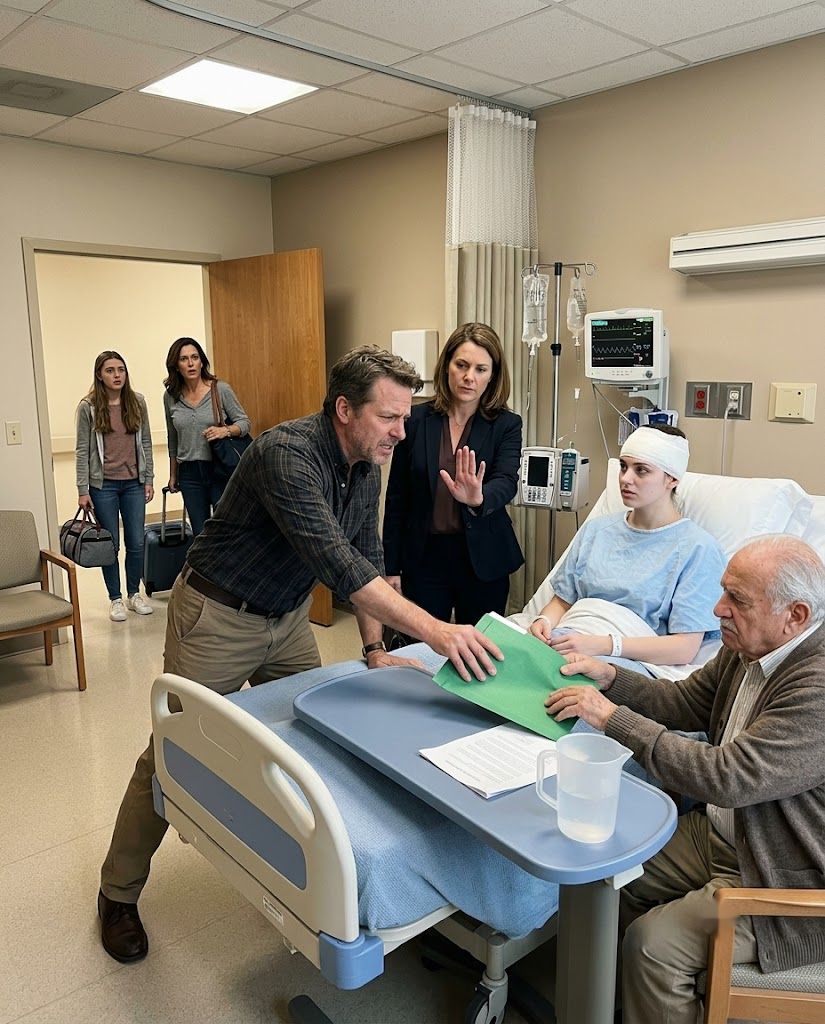
Before she could explain further, my hospital-room door flew open.
Dad came in first.
Mom and Chloe were behind him with airport bags still hanging from their shoulders.
They had apparently taken the first reasonable flight home once Grandpa's proxy revocation froze Dad's corporate travel authority and the finance office began declining expenses.
Dad did not ask how I felt.
He barely glanced at the bandage around my head.
His eyes landed on the green folder.
"Give me that."
He reached across my tray.
Grandpa pulled the folder backward before Dad's fingers touched it.
Rebecca stepped between them and raised one hand.
"Richard, don't."
Dad's face reddened.
"This is family business."
Grandpa stared at him.
"She is the family member whose signature we're discussing."
Rebecca opened the folder and placed one page in front of me.
At the bottom was my name.
Ava Mercer.
The signature looked almost perfect.
Dad stopped moving.
Rebecca tapped the notarization box.
"Before you touch another thing," she said, "explain why Ava supposedly signed this shareholder consent at 10:42 Saturday morning—while paramedics were carrying her unconscious from the commencement stage."
Dad stared at the time.
"It's an administrative error."
Rebecca turned the document toward him.
It was not a harmless administrative form.
The consent transferred voting control of my newly vested eight-percent stake to Mercer Management Partners, an entity Dad controlled, for another ten years.
It gave that entity broad authority to vote the shares, approve certain transactions, and receive confidential shareholder notices on my behalf.
According to the document, I had signed voluntarily in front of a notary at Mercer Development's headquarters.
At 10:42 that morning, however, the university livestream showed me standing at the commencement podium.
Minutes later, emergency-service records documented paramedics treating me behind the stage.
I looked at Dad.
"So when exactly was I in your office?"
Mom whispered, "Richard."
He ignored her.
Then Chloe looked at the bottom of the page.
The color disappeared from her face.
"Dad told me it was temporary."
Every person in the room turned toward her.
Dad snapped, "Be quiet."
Rebecca immediately picked up her legal pad.
Grandpa asked Chloe what Dad had told her was temporary.
She covered her mouth.
"I didn't know what the paper was," she said. "He just needed the file sent before we left."
Dad stepped toward her.
Rebecca moved between them.
"Nobody needs to explain anything without counsel," she said. "But nobody is destroying or altering evidence either."
She reached into the green folder and removed a small encrypted flash drive.
"We had the original electronic document preserved and examined," she said. "Including its creation history and the email chain attached to the upload."
Dad took one step backward.
That was the moment I understood he was no longer angry because Grandpa was overreacting.
He was afraid because he knew what was on the drive.
Rebecca connected it to her secured laptop.
The first item was a forensic report from an independent document examiner Mercer Development's audit committee had retained that morning.
My signature had not been written fresh on the shareholder consent.
It had been copied from a scholarship acknowledgment I signed two years earlier.
The examiner identified matching digital edges, identical pen-pressure artifacts, and scaling patterns that would be virtually impossible in two separate handwritten signatures.
Dad shook his head.
"That's speculation."
Rebecca did not argue.
She opened the document metadata.
The consent had been created on Dad's company laptop Friday night.
A scanned image containing my signature had been inserted shortly afterward.
The file had then been forwarded Saturday morning to Chloe's personal email account with instructions to upload it through a remote executive portal because Dad claimed his connection was unreliable.
Chloe began crying.
"You said she already agreed."
Dad turned toward her.
"You were supposed to send a file. That's all."
Rebecca opened the email.
Dad's own message was attached.
He had written that I was "too emotional about graduation" to discuss paperwork and that the filing needed to be completed before Grandpa realized my shares had vested.
A second sentence was worse.
He told Chloe not to mention the consent because he would "deal with Ava after Rome, when she calms down."
I looked at him across the hospital room.
For years, he had told me I misunderstood things.
I was too sensitive.
Too anxious.
Too dramatic.
Now those same words sat inside a preserved corporate email explaining why he believed my consent was optional.
Mom sank into the visitor chair.
"Richard, tell me you didn't do this."
He looked at Grandpa instead.
"I protected the company. Ava knows nothing about running Mercer Development."
Grandpa's voice stayed quiet.
"Then you could have asked her to appoint a voting representative."
"She would have said no."
"Exactly."
Dad's mouth closed.
Rebecca then opened the financial report.
The Rome trip had not merely been coded incorrectly by an assistant.
Dad had personally approved the expense authorization, listing two supposed European investors as attendees.
The audit committee had contacted both companies.
Neither had meetings scheduled with him.
One executive had never even been in Italy that week.
The family flights, hotel suites, restaurants, drivers, and Chloe's luxury purchases had all been submitted as business expenses.
The total was just over $71,000.
That amount did not destroy Mercer Development.
The dishonesty did.
Grandpa explained that the board had already been notified. Dad's authority over discretionary company accounts had been suspended pending investigation.
His voting proxy was gone permanently.
My eight-percent stake had been restored to direct control under the terms of Grandma's trust.
I did not suddenly become CEO.
Nobody handed me a corporation because I had suffered.
I was a twenty-two-year-old recovering from brain surgery, and I understood exactly how little I knew about running a large company.
What changed was simpler.
Dad no longer had the right to make decisions in my name.
Rebecca asked me whether I had ever authorized the shareholder consent.
"No."
"Did you authorize anyone to reproduce your signature?"
"No."
"Did you know this document existed before today?"
"No."
She wrote each answer down.
That statement, together with the electronic evidence, went to the independent directors overseeing the investigation.
The hospital records and graduation footage established that I could not possibly have appeared before the notary when the consent claimed I had.
The company also retained outside counsel to examine the notarization and determine whether it needed to be referred to state authorities.
Dad finally looked at me.
"Ava, you don't understand what you're doing to this family."
The sentence sounded almost familiar enough to hurt.
I looked at the IV in my arm, the bandage around my head, and the hospital contact log lying beside Rebecca's laptop.
"I didn't make any of these records," I said. "I just stopped hiding them."
He had no answer.
The board placed Dad on administrative leave that afternoon.
Three weeks later, after reviewing the expense records, the forged consent, and several unrelated transactions uncovered during the audit, the directors voted to remove him as CEO for cause.
The company reached a repayment agreement covering the personal travel expenses and other improperly charged costs identified by the audit.
The disputed shareholder consent was formally voided.
The questionable notarization and signature evidence were turned over to the appropriate outside lawyers and authorities for review rather than handled privately inside the family.
Chloe cooperated with the investigation.
She admitted uploading the document but maintained that Dad had told her I had already approved it.
The emails supported part of her account, but they did not erase what she had done afterward.
She had received the hospital messages.
She knew I was in emergency surgery.
And she still posted that photograph about enjoying a vacation without emergencies or guilt trips.
A month after surgery, she came to my apartment and apologized.
Not the kind of apology our family usually gave, where the word sorry was followed immediately by a reason the injured person had caused the problem.
She simply said, "I treated you like Dad treated you because it was easier than admitting what he was doing."
I told her I appreciated the apology.
I did not tell her everything was fine.
It wasn't.
Mom struggled longer.
At first she insisted Dad had been under enormous pressure. Then she said the company had always been complicated. Then she asked whether one bad decision should erase decades of family history.
I finally told her the problem was not one decision.
It was the habit of requiring me to absorb every decision so nobody else had to feel uncomfortable.
She cried.
I did not change my answer.
Grandpa never asked me to take Dad's place.
Instead, he helped the board hire an interim chief executive and strengthen its controls so no one person could again combine family authority with unchecked corporate authority.
My shares remained mine.
Rebecca arranged independent financial education for me so I could understand what I owned without depending on another relative to explain it.
That mattered more than any title.
The pathology report eventually came back showing that the mass had been completely removed and required monitoring rather than another immediate operation.
Recovery was slow.
I had headaches, physical therapy, follow-up scans, and days when reading for twenty minutes exhausted me.
Tessa drove me to appointments whenever Grandpa could not.
Marisol mailed me a card signed by several nurses from the floor.
At my first follow-up appointment, the neurosurgeon showed me the scan from graduation morning and explained again how close the timing had been.
For years, my family's favorite accusation had been that I made things bigger than they were.
That scan taught me something different.
Sometimes a thing is exactly as serious as it feels.
Sometimes the responsible response is not to minimize it.
Sometimes survival begins with allowing the truth to remain its actual size.
Six months later, my university invited me back for a small ceremony because I had never received my diploma after collapsing.
There were no thousands of people this time.
No stadium.
No giant stage.
Just a dean, a few professors, Tessa, Grandpa, and a row of chairs in a quiet auditorium.
Mom asked whether she could come.
I said yes.
Chloe asked too.
I told her she could sit with Mom.
Dad did not attend.
We were still not speaking.
Before the ceremony began, I noticed something strange.
There were more chairs than people.
For a moment, the sight of the empty seats pulled me straight back to graduation morning.
Then Grandpa touched my shoulder.
"Ready?"
I looked at the people who had actually shown up.
"Yeah," I said.
And this time, when I walked across the stage, nobody had to pretend the empty chairs meant more than the occupied ones.

